An operating system for human creativity
Inspiration
It arises when the realm of plausibility is as wide as possibility itself. But without the right training or tools, inspiration is fleeting—it contains the opportunity of the future one moment and disappears into the past the next. Artists spend their lives improving their odds in the fight against entropy.
Confrontation
If inspiration holds potential, technique holds the key. That’s why musicians practice their scales and painters rehearse their stroke—all to have a shot at creating value. The work is learning how to sustain the balance between art and craft. Too often, our tools force us to fortify one while sacrificing the other.
Saturation
After enough tradeoffs, inspiration becomes merely a word. The original vision no longer drives us—we’re too busy putting out fires. The balance between art and craft collapses. We reach for more tools to ease the friction, but most of them just help us think less, not more.
A Truly Visual Environment
We don’t need another workspace. We need an operating system for human creativity.
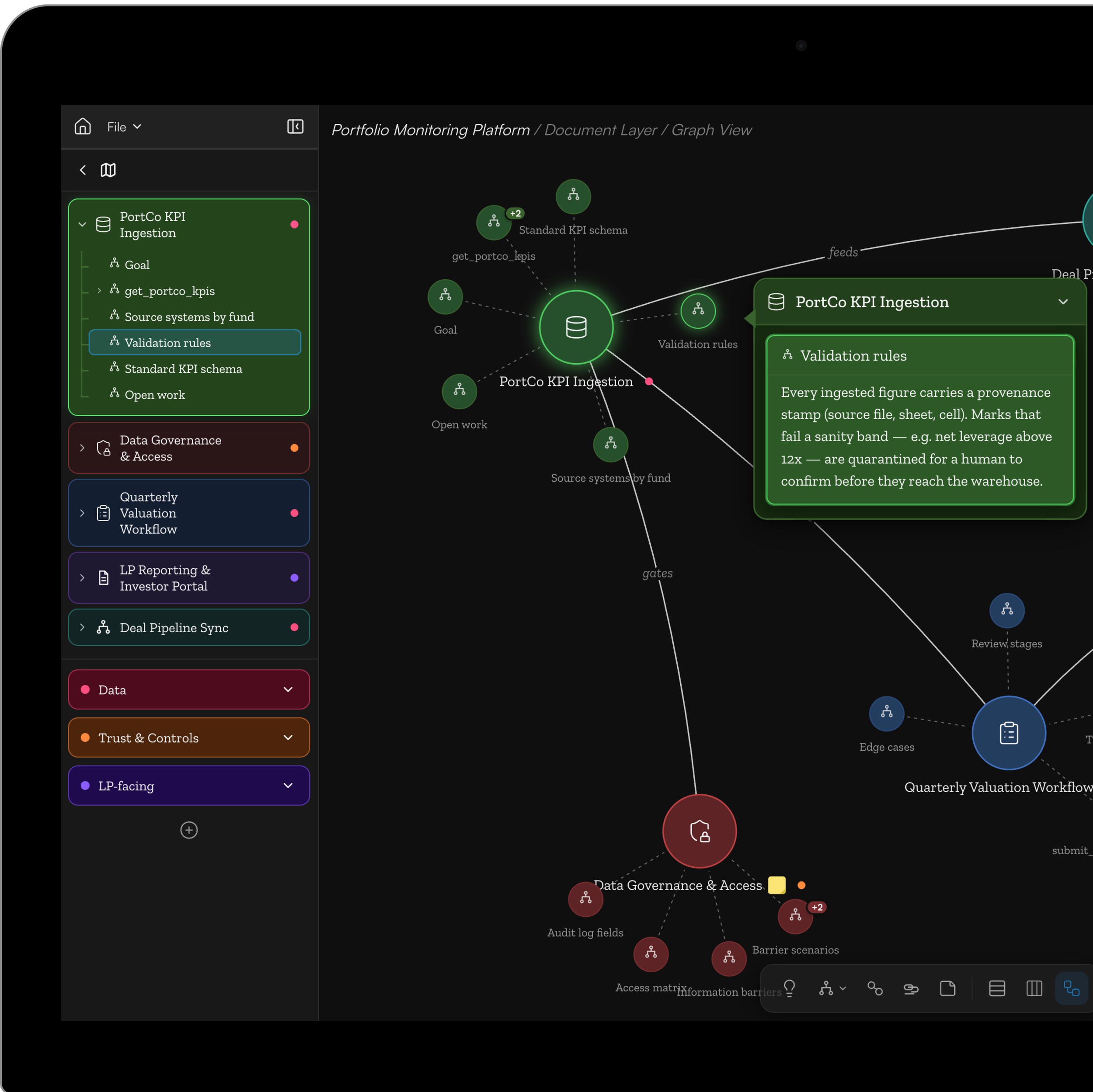
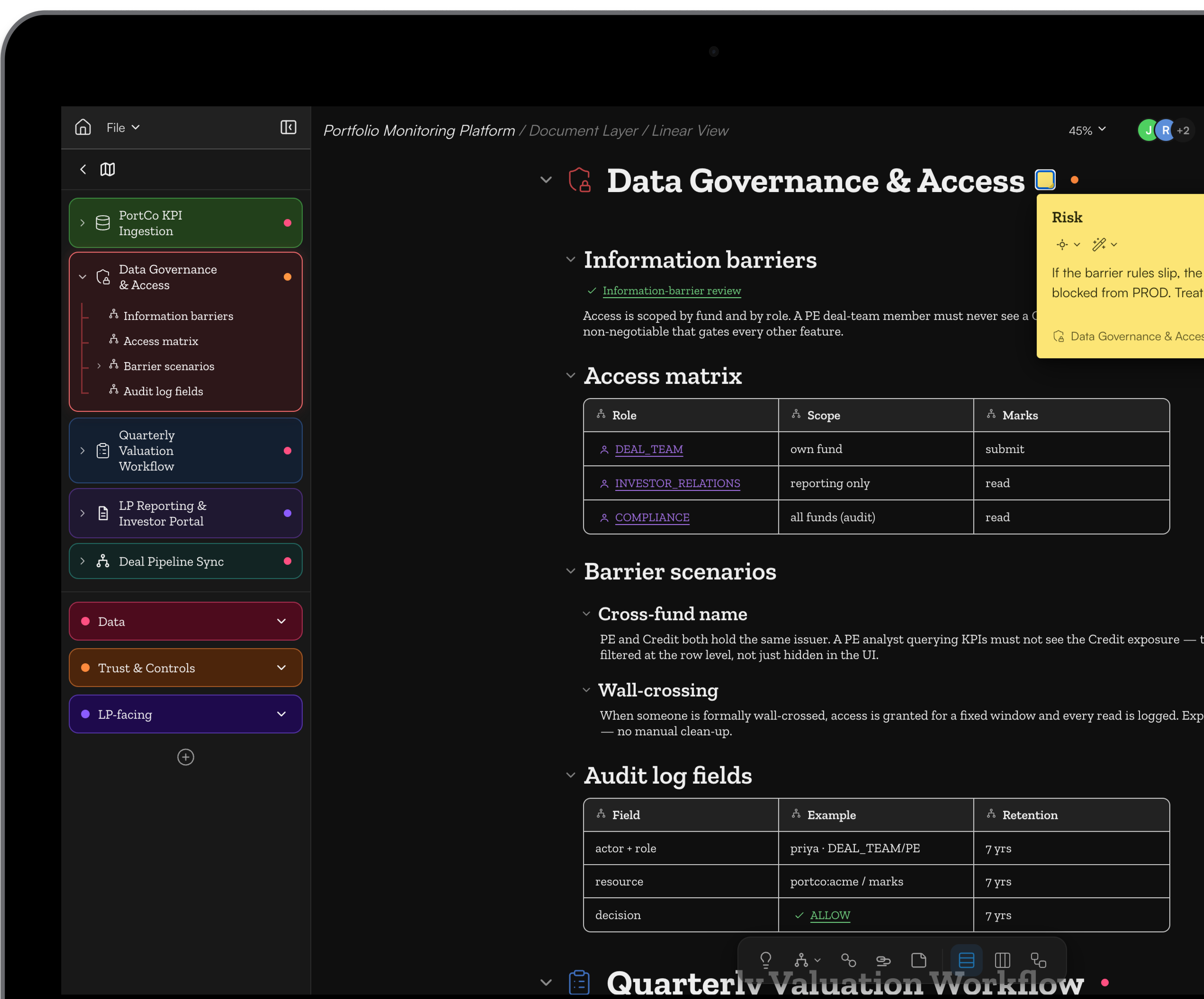
Ideas aren’t one-dimensional, so neither should be our software. Concepts give ideas breadth. Layers give them depth. Relationships give them meaning. Some thoughts are intentional. Others arrive without warning and need somewhere to land right away.
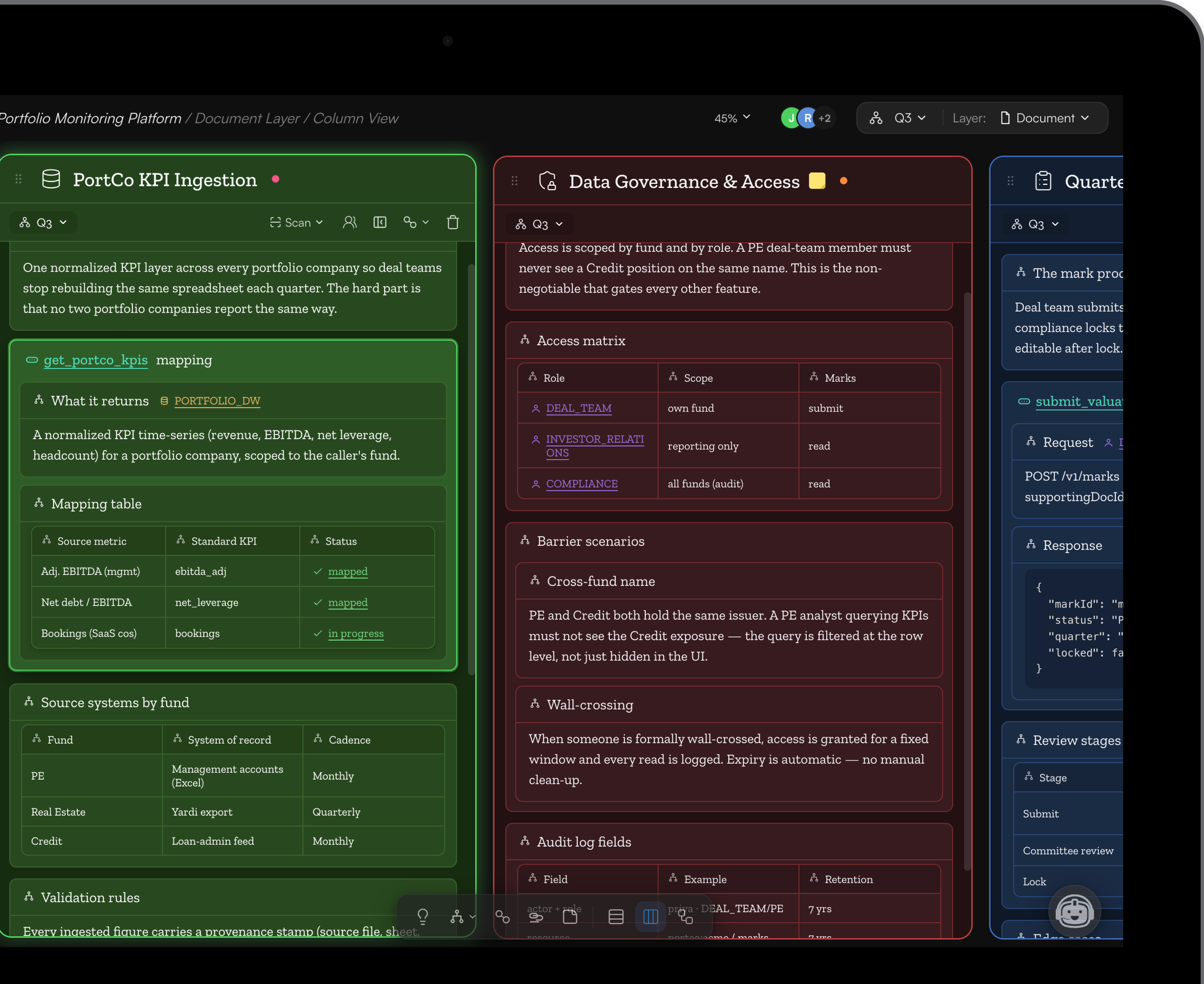
Everything should exist in the open. Not buried in folders. Not trapped in our heads. Work should move freely—left, right, up, and down.
The technology should bend to the way we think, not the other way around.
Concepts + Layers
Concepts define the scope of an idea. They spread outward, setting boundaries without constraining possibility. Layers deepen those ideas, creating space for detail, nuance, and iteration without collapsing the structure that holds everything together.
The result isn’t a document or a diagram, but a system of interlocking parts that can grow, shift, and recombine without breaking. When ideas connect this way, they stop being static artifacts and start behaving like what they actually are: evolving structures of thought.
That’s a MindMosaic.
Meet the Founder
Manchester, UK - 2022
My name is Dan Sagher. Music was my first love, and it’s what guides me in creating MindMosaic.
As a musician, it was common to hear the phrase “always serve the song.” It reinforced the idea that no matter what technical skill we were practicing, it only mattered if it served the music itself.
So when I was learning to code—struggling to visualize the complex flow of data from one line to the next—I noticed something. When I drew diagrams in my notebook, everything made sense. When I went to implement my solution in code, that clarity faded. The gap between inspired visualization and technical execution was too wide for me to ignore.
That gap exists because we’ve accepted the idea that tools must be either visual or technical. The closest we’ve come to combining them is making the switch between the two as seamless as possible. I see this as a bandage, not a solution.
But this phenomenon isn’t exclusive to coding. Any meaningful knowledge work relies on ideas connecting clearly. A personal essay, for instance, only moves the reader when its arguments build on one another coherently. If the structure is incomplete, so is the work. When ideas are always at our fingertips, we can dive deep while never losing the plot.
I believe our software should encourage us to question what we’re building at every turn, so we don’t waste energy chasing dead ends. We should be able to see how our work grows, so it doesn’t drift into something we no longer recognize. Our tools should help us carry ideas from inspiration through execution, intact.
In other words, our software should be there every step of the way—reminding us to always serve the song.